submitted by Lark M. Robart
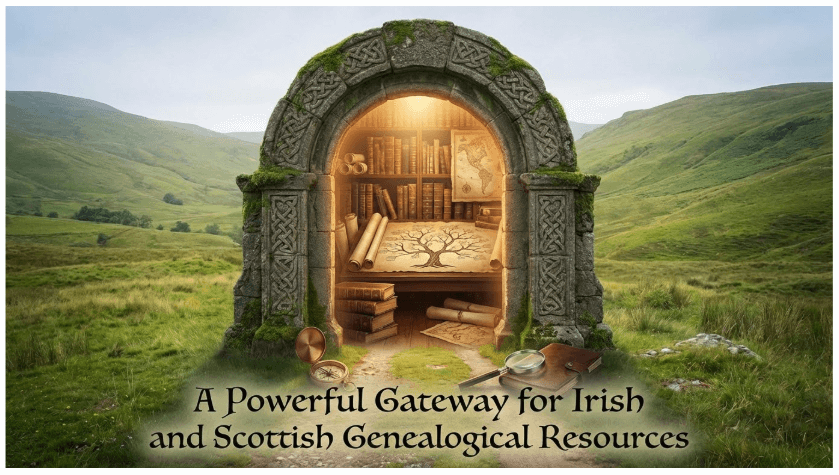
Genealogical research in Ireland and Scotland can feel daunting—fragmented records, shifting jurisdictions, and the well-known loss of early census material often leave researchers unsure where to turn next. One exceptionally valuable aid in navigating this complexity is Websites for Irish & Scottish Genealogical Research, compiled by AGS member and Celtic SIG Moderator Marty Brady and updated through early 2026.
This extensive resource brings together hundreds of carefully curated websites—more than 265 entries—organized in a way that mirrors how experienced researchers actually work.
What makes this resource stand out
Rather than functioning as a simple link list, this compilation is structured as a research framework:
- Topical sections covering cemeteries, census substitutes, civil records, land and property, deeds, maps, newspapers, wills, workhouses, religious records, and more
- County-by-county coverage for all 32 Irish counties, organized by province (Leinster, Munster, Connacht, and Ulster); and 33 Scottish counties
- A dedicated section for Scottish resources, making it especially helpful for researchers tracing movement between Ireland, Scotland, and the wider diaspora
- Strong representation of local archives, historical societies, parish projects, and county libraries—sources that are often missed in general online searches
Many of the included websites point to original or near-original material: transcriptions, digitized manuscripts, estate papers, valuation books, parish registers, and historical maps.
Why this matters for researchers
Irish and Scottish genealogy often requires moving beyond single databases and learning how to layer evidence from multiple substitute records. This guide helps researchers:
- Identify appropriate sources when civil or census records are missing
- Understand where local knowledge is preserved
- Discover lesser-known county and parish projects
- Work more efficiently by starting with trusted repositories
For newer researchers, it provides orientation. For experienced genealogists, it serves as a current, consolidated reference—especially valuable given how frequently websites change or disappear.
How to use it effectively
This resource is best approached strategically rather than sequentially. Start with a research question (for example, land occupancy, parish identification, or a missing individual), then consult the relevant topical section and county listings. Used this way, it becomes a roadmap rather than a rabbit hole.
A note on currency and care
The compiler notes that while the list has been recently updated, websites can change. Users are encouraged to report broken links and to view the document as a living guide rather than a static directory.
In short:
This compilation is a generous, practical gift to the genealogical community—one that rewards both careful reading and purposeful use. Whether you are beginning Irish or Scottish research or refining long-standing projects, it provides a reliable place to start and a steady hand when records seem elusive.
Acknowledgment:
This post was drafted with the assistance of ChatGPT, an AI language tool, using prompts and guidance I provided. I reviewed and edited the final text, and remain fully responsible for its content. I share this in the spirit of transparency and evolving research and writing practices.