2025 Monthly Programs
DATE RECORDED: November 12, 2025
TITLE: Our Veteran’s Voices: Armistice Day-Why We Remember
PRESENTER: Stu Murray
DESCRIPTION: A presentation honoring those who served.
Click here to watch the recording.
DATE RECORDED: October 8, 2025
TITLE: The Road from Research to Writing
PRESENTER: Karen Jones
DESCRIPTION: You’ve been researching your family history for years. Now what are you going to do with what you have learned? You probably want to pass it on to future generations, but how and where to start? AGS member Karen Jones has traveled that winding road from research to writing and will discuss the journey with us in a Zoom meeting. We will talk about the obstacles we face, the fears, the options, the motivation, and the importance of encouraging each other. Mike Blackledge and Molly Shannon will also share their experiences. Join us for a pep rally for your own journey.
Click here to watch the recording and here to download the handout.
DATE RECORDED: September 10, 2025
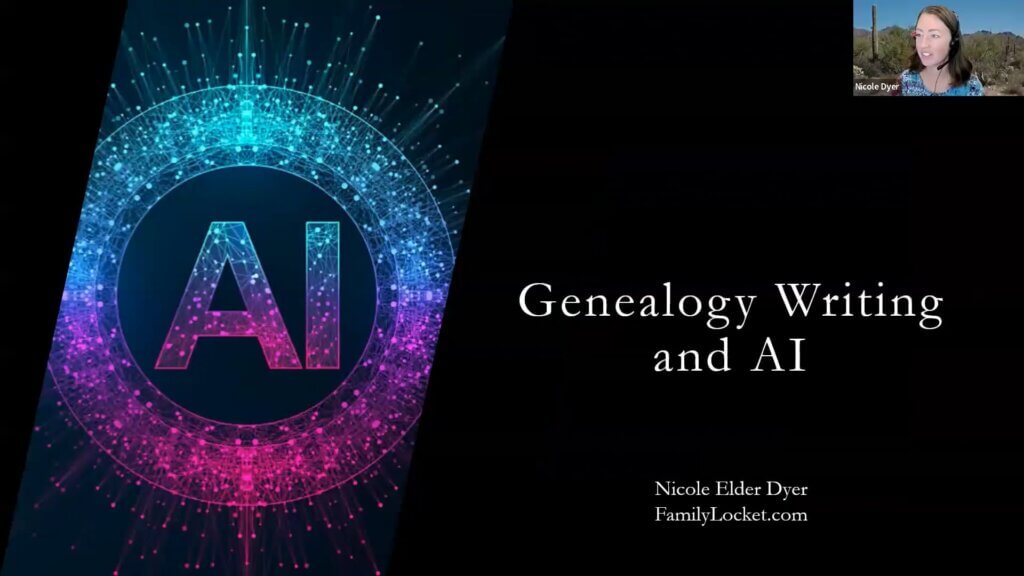
TITLE: Genealogy Writing and AI
PRESENTER: Nicole Dyer
DESCRIPTION: Writing about your genealogy research can be challenging. Assembling genealogical conclusions requires time, persistence, and dedication. Learn how generative AI tools can help – whether you’re writing a biography, research report, or proof argument. Tools like ChatGPT and Claude can turn research logs into reports and timelines into narrative. Providing text to the AI tools helps increase accuracy and limit errors. Generative AI tools can increase your writing efficiency, but your personal style may be lost. Learn how to maintain your unique voice while increasing productivity. We will also discuss when to disclose writing assistance from AI tools and how to cite them.
Sorry, pursuant to our contract with the speaker, this recording is no longer available.
EVENT DATE: August 13, 2025
SUMMER STORIES: For many years, we have had an annual, in-person storytelling meeting where we share our accomplishments with like-minded family researchers. Since many of us are in families who are not enthusiastic about family history research, we need to take time to listen, encourage, help, rejoice, or sympathize with each other. We divide into small groups that allow everyone to tell of their recent genealogical adventures. We also collected ideas for next year’s programs.
No recording was made of this event.
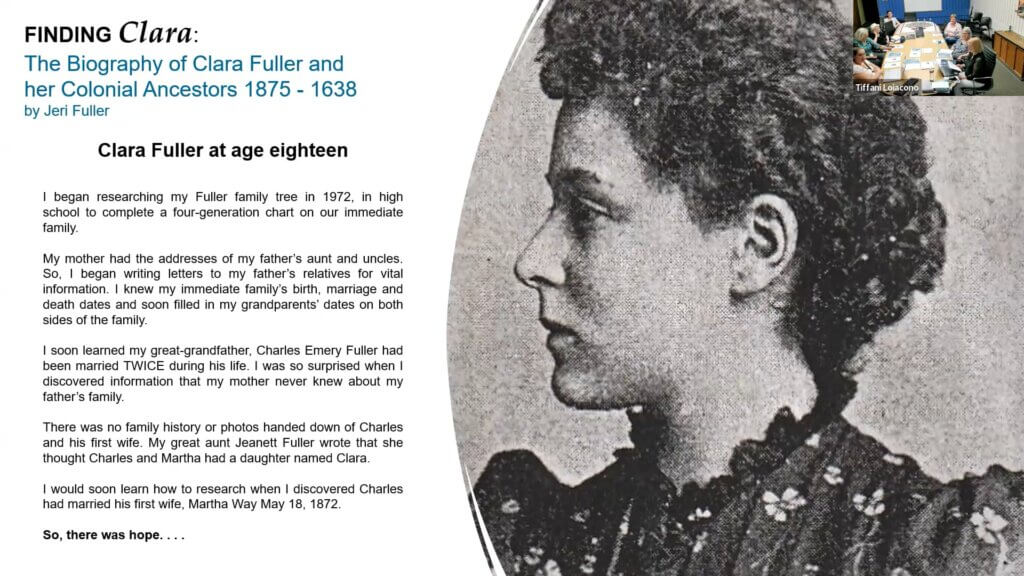
DATE RECORDED: July 9, 2025
TITLE: Finding Clara
PRESENTER: Jeri Surad
DESCRIPTION: “Finding Clara is a result of a single genealogical lead that became a family mystery in 1972. My great-grandfather, Charles Emery Fuller, and his first wife, Martha, had a daughter named Clara in 1875. She was born in Northfield, Minnesota. My mother did not know of Clara or that he had been previously married because there was no family history, stories, or photos handed down of Clara or her mother. The one thing I knew for sure was the more family history I found, the more I knew there was more to find! I have enjoyed traveling to the towns and cities my ancestors once lived across America. I published my Fuller family’s history in, Finding Clara: The Biography of Clara Fuller and Her Colonial Ancestors, 1875 – 1638, published in 2022.” – Jeri Surad
Click here to watch the video and here and here to download the handouts.
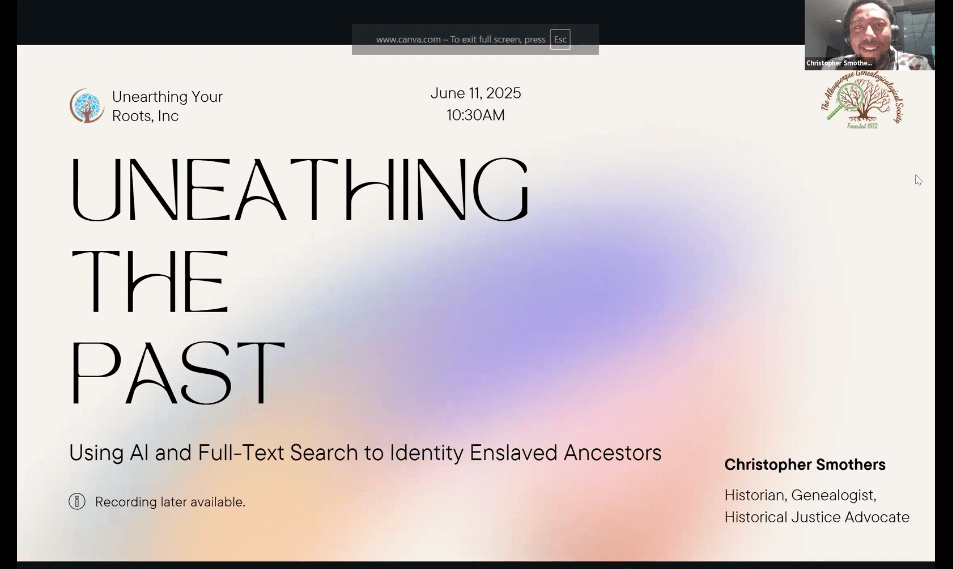
DATE RECORDED: June 11, 2025
TITLE: Using AI and Full-Text Search to Identify the Formerly Enslaved
PRESENTER: Christopher Smothers
DESCRIPTION: Traditional genealogical research on formerly enslaved individuals is often hindered by incomplete records, name changes, and fragmented historical documentation. However, advancements in artificial intelligence and full-textual search technologies are transforming the ways we uncover and connect ancestral histories. This talk explores how AI-driven tools and full-textual search methods can be leveraged to identify the formerly enslaved within historical records, legal documents, and newspapers. We will discuss strategies for extracting meaningful insights from digitized archives, handling name variations and misspellings, and piecing together fragmented narratives. Attendees will gain practical knowledge on integrating AI-powered research techniques into their genealogical investigations, helping to combat historical erasure and restore lost family lineages.
Click here to watch the video.
DATE RECORDED: May 14, 2025
TITLE: Genealogical Estate Planning
PRESENTER: AGS Member Karen Jones
DESCRIPTION:Most genealogists have spent thousands of hours doing research and collecting records of past generations. How much time have we spent preparing to pass our treasures on to the coming generations? We, of all people, know the uncertainty of life. What can we do to ensure that our work will survive us? Karen Jones will share with us a step-by-step process for preparing our work to be distributed when we are gone.
Click here to watch the video and here, here and here to download the handouts.
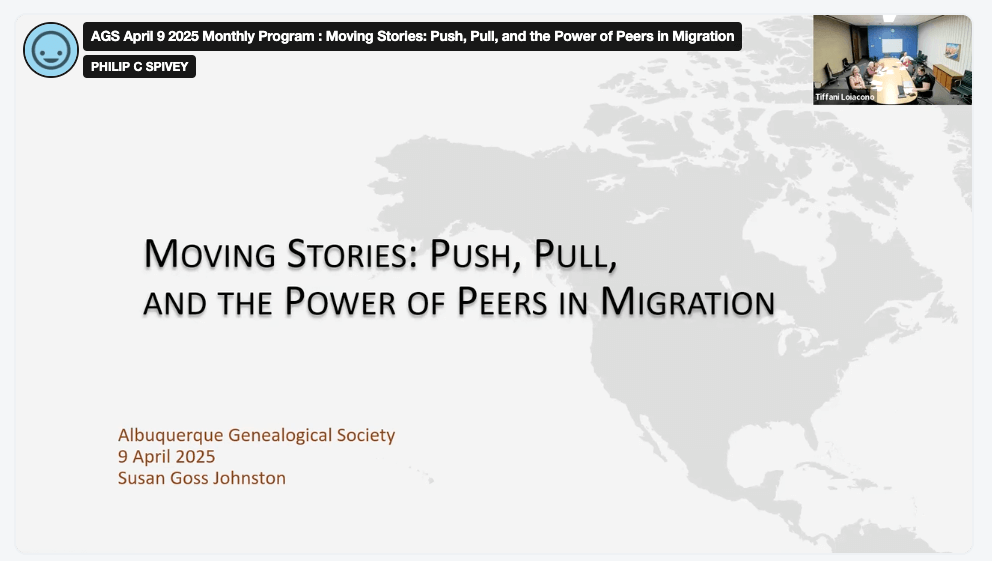
DATE RECORDED: April 9, 2025
TITLE: Moving Stories: Push, Pull, and the Power of Peers in Migration
PRESENTER: AGS Member Susan Johnston
DESCRIPTION: “Where did they come from?” “Where did they go?” “Is the John Smith who died in Wisconsin really the one who grew up in Pennsylvania?” Whether your subject disappeared from Connecticut after the Revolutionary War or appeared out of the blue in Idaho in 1875, understanding migration dynamics will provide important research clues and prepare a strong foundation for research conclusions. These small case studies illustrate migration dynamics in action.
Click here to watch the video and here to download the handout.
DATE RECORDED: February 12, 2025
TITLE: Record As You Go, Cite As You Go, & File As You Go
PRESENTER: Cyndi Ingle
DESCRIPTION: Genealogists tend to get very excited about new records and sources they come across in their research. So much so that they grab a quick copy, download it to default folders, and move on to the next item without thoroughly exploring the source first. All too often they don’t take the time to evaluate the source, to write the citation(s) for the source, or to file it in the correct spot. We have to slow down and take the time to think, to file, and to create notes about the source that make it easy to find that source again if needed. Doing this keeps our research more organized, but also keeps our research brain tidy as well. We are much more productive when we can easily put our hands on what we’ve found in the past. We will explore different options for accomplishing all of these important steps.
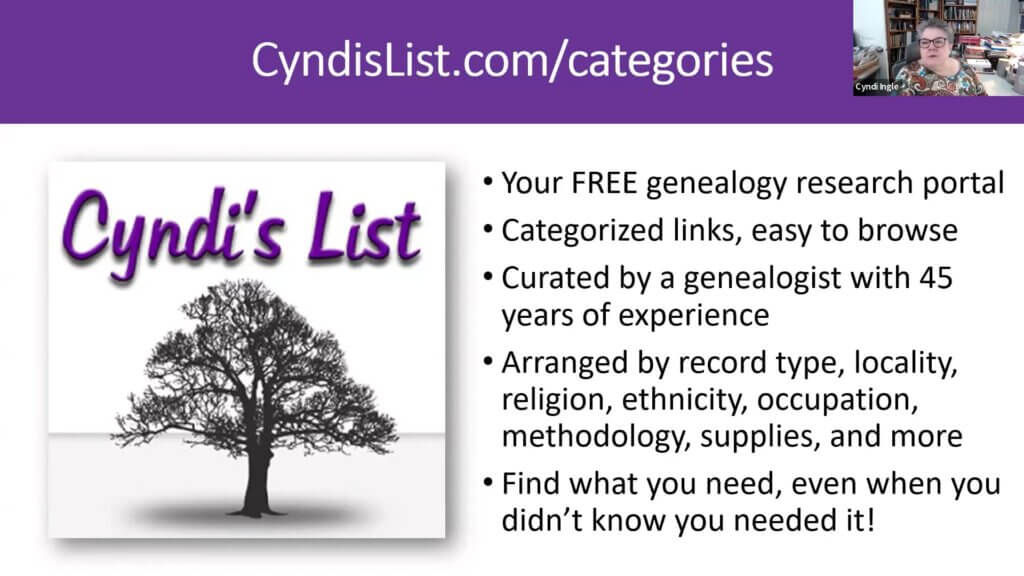
Cyndi Ingle has been a genealogist for more than 43 years, is the creator and innovator behind the award-winning and globally recognized CyndisList.com. Cyndi is an expert in using technology for genealogy, research in the United States and bringing together traditional methodology with organization, computers, software, and the Internet. She is an internationally-known guest lecturer, and she has authored numerous articles and three books. Cyndi is the Executive Director for the Institute of Genealogy and Historical Research. She is a columnist for the Association of Professional Genealogists Quarterly.
IMPORTANT NOTES:
Sorry, pursuant to our contract with the speaker, this recording is no longer available.